Thursday, December 06, 2007

[French bombing & Muslims] France: Deadly Bombing in Paris

[French bombing & Muslims] France: Deadly Bombing in Paris
12-6-2007

France: Deadly Bombing in Paris Stratfor Though the situation in France is tense after weeks of large-scale strikes and riots in the Muslim suburbs surrounding Paris -- as well as recent problems ...
http://www.stratfor.com/products/premium/read_article.php?id=299540&selected=Analyses
(Excerpt) Read more at stratfor.com ...

Technorati -


Labels: , , , , , ,

Monday, November 26, 2007

Muslims Rioting in Paris after Muslim Youths Killed


From: http://www.outsidethebeltway.com/archives/2007/11/rioting_in_paris_after_muslim_youths_killed/

Rioting in Paris after Muslim Youths Killed

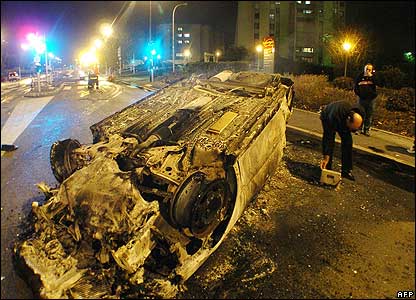
Rioting has been ongoing in the Paris suburbs for hours after the deaths of two teenagers in what appears to be an accidental crash with a police vehicle.


French Muslim Riot Photo After the accident, looting broke out and the police station in Villiers-le-Bel was set on fire, as was a local petrol station, with a number of cars destroyed.
Details are a bit sketchy in the early reports.“Riot grips Paris suburb after youths killed in police crash,” AFP


French police were on alert Monday for a new flare-up of violence in the Paris suburbs, after the death of two teenagers in a crash with a police car sparked six hours of rioting by angry youths.

Gangs torched cars and looted shops and buildings in the north Paris suburb of Villiers-le-Bel, injuring 25 police officers, following the death of the youths aged 15 and 16, whose cross-country motorbike collided with a police car at around 5:00 pm (1600 GMT) on Sunday. Some 100 angry youths quickly thronged the crash site, in a flashpoint high-rise housing estate, demanding the “truth” about the accident, as rioting spread across the town.

In 2005, the accidental death of two youths allegedly fleeing police in another north Paris suburb sparked three weeks of riots in suburban estates across France, the country’s worst social unrest in decades.

Omar Sehhouli, the brother of one of Sunday’s victims, accused police of ramming the motorbike and of failing to assist the injured teens. “This is a failure to assist a person in danger… it is 100-percent a (police) blunder. They know it, and that’s why they did not stay at the scene,” he told France Info radio. “I know they will say they left because they were afraid of clashes or of being assaulted… but up until now we have had no apology from the police chief.”

Police said the bike smashed into the side of their car during a routine patrol of the neighbourhood. Neither youth was wearing a helmet, according to witnesses. An internal police investigation has been opened.

Officials reported at least seven arrests in Villiers-le-Bel as rioters torched two garages, a petrol pump and two shops, pillaged the railway station in neighbouring Arnouville and set fire to more than 20 cars. Twenty-five police were injured in the violence, two seriously, as well as one firefighter, officials said Monday. A police station Villiers-le-Bel was set on fire and another in Arnouville was wrecked. Police said there were reports of “small groups attacking shops, passers-by and car drivers” to rob them. One suspect was arrested carrying jewelry from a looted store, they said.

Sehhouli told AFP the rioting “was not violence but an expression of rage,” saying he wanted the police officers “responsible” for the accident to be brought to justice.

“Boys’ moped deaths ignite riot in Paris suburb,” London Telegraph.


French police were on alert Monday for a new flare-up of violence in the Paris suburbs, after the death of two teenagers in a crash with a police car sparked six hours of rioting by angry youths.

Gangs torched cars and looted shops and buildings in the north Paris suburb of Villiers-le-Bel, injuring 25 police officers, following the death of the youths aged 15 and 16, whose cross-country motorbike collided with a police car at around 5:00 pm (1600 GMT) on Sunday. Some 100 angry youths quickly thronged the crash site, in a flashpoint high-rise housing estate, demanding the “truth” about the accident, as rioting spread across the town.

In 2005, the accidental death of two youths allegedly fleeing police in another north Paris suburb sparked three weeks of riots in suburban estates across France, the country’s worst social unrest in decades.

Interestingly, those without background knowledge of the 2005 riots would have no idea from reading these stories that the “youths” killed, those perpetrating the riots, and the suburbs in question were predominantly Muslim and that ethnic unrest was the tinder sparked by the incidents. Indeed, there’s no clue in either story other than the name of the brother, Omar Sehhouli, who is quoted in both pieces and this, in the 17th paragraph of the AFP report:


Police and politicians warn many French suburbs remain a “tinderbox” two years after riots which exposed France’s failure to fully integrate the French-born descendants of African and Arab immigrants.

Rather important information, no? One can’t imagine rioting and the throwing of Molotov cocktails at police in most Western suburbs as a result of an accident. Surely, some explanation is warranted.

Photo credit: BBC


Labels: , , , , , , , ,

Wednesday, November 07, 2007

Eiffel Tower lookin' good tonight - Sarkozy: America can count on France

Sarkozy: America can count on France
Baltimore Sun, United States -

And because of that America can count on France in its battle on terror.” America might also be able to count on France as a full partner in NATO. ...

http://weblogs.baltimoresun.com/news/politics/blog/2007/11/sarkozy_america_can_count_on_f.html

Bush-Sarkozy Text

Wednesday November 7, 2007 10:16 PM
By The Associated Press

Text of the news conference Wednesday by President Bush and French President Nicolas Sarkozy at Mount Vernon, Va., as transcribed by CQ Transcriptions.

BUSH: Mr. President, welcome. Thank you very much for coming here to Mount Vernon. And thank you for coming to the United States.

I think it's safe to say that you've impressed a lot of people here on your journey. You bring a lot of energy, enthusiasm for your job, love of your country and a strong set of universal values in your heart.

We've just had an extensive conversation, one that you'd expect good friends to have.

We talked about Iran and the desire to work jointly to convince the Iranian regime to give up their nuclear weapons ambitions for the sake of peace.

We talked about the Middle East and the upcoming talks at Annapolis, Maryland.

We spent some time on Kosovo, and I appreciate the president's leadership on Kosovo.

I can't thank the president enough for his willingness to stand with young democracies as they struggle against extremists and radicals. And one such democracy is Afghanistan.

Mr. President, your leadership on that issue for your country was very impressive. You sent a very clear message. It's clear that you're a man who does what he says he's going to do. It's the kind of fellow I like to deal with.

And so, Mr. President, I also want to thank your administration and your strong stance for human rights and human dignity. Whether they be those who are oppressed in Burma or Darfur or on the island of Cuba, France's voice is important and it's clear that the human rights of every individual are important to the world.

And I look forward to advancing peace and freedom with you, Mr. President. Our bilateral relations are important. They are strong. And we intend to keep them that way.

And so welcome here to George Washington's old home. Proud to have you in America. Thanks for coming.

SARKOZY (THROUGH TRANSLATOR): I want to thank President Bush, his administration, and all Americans, who have welcomed us in such exceptional fashion. I get the distinct sense that it is France that has been welcomed so warmly, with so much friendship, so much love. This was my hope, my ambition. And with Bernard Kouchner, Christine Lagarde, Rachida Dati and myself, this is exactly what we wanted.

We have been very moved, deeply moved, by your wonderful welcome, together with Mrs. Laura Bush yesterday at the White House. I especially enjoyed the skit of the dialogue between George Washington and Lafayette that we witnessed.

The tokens of friendship that we have seen since we have been here, your open-mindedness, and the fact that we can address any and every subject, all those that you mentioned, sir, even though the European defense policy and NATO have also been addressed, environmental issues, which are close to our heart, and Afghanistan.

I said that we would stay there because what is at stake is the credibility of the Atlantic Alliance and the fight against terror.

We spent hours discussing important issues, commercial, economic and others, and I would say that we have done so in a spirit of openness and trust and that is something I have been particularly struck by. And I can tell you, that this visit I think has been very widely covered in France.

And when I say that the French people love the American people, that is the truth and nothing but the truth.

Now, I spoke at length this morning, and I think the best would be that after President Bush, whom I wish to thank once again, we could answer any questions you may have.

Q: Mr. President, you came down so hard on Burma and other nations for their crackdowns on pro-democracy demonstrators, yet you seem to be giving Musharraf a pass. So the question is, why are you going so soft on Musharraf? Is there a double standard?

BUSH: I spoke to President Musharraf right before I came over here to visit with President Sarkozy. And my message was that we believe strongly in elections and that you ought to have elections soon, and you need to take off your uniform. You can't be the president and the head of the military at the same time.

So I had a very frank discussion with him.

Look, our objective is the same in Burma as it is in Pakistan, and that is to promote democracy.

There is a difference, however. Pakistan has been on the path to democracy. Burma hadn't been on the path to democracy. And it requires different tactics to achieve the common objective.

And as I told you, I just spoke to President Musharraf before I came here and my message was very plain, very easy to understand, and that is, the United States wants you to have the elections as scheduled and take your uniform off.

You want to call on somebody?

SARKOZY (THROUGH TRANSLATOR): In France, I don't choose - I don't pick the journalists.

BUSH: You don't get to choose? Who chooses?

I choose?

Who would you like me to choose?

Oh, he chose. Wait a minute, didn't last very long, did it?

SARKOZY (THROUGH TRANSLATOR): I didn't choose. I indicated a general direction.

Q: Thank you, Mr. President.

My question is on Iraq. Mr. President, this morning you talked at length about Afghanistan, Iran, but not Iraq.

And I wanted to ask both of you: Is France reconciled with the United States, as the United States is reconciled with France?

So what about Iraq?

Can France, for instance, help to get out of the Iraqi quagmire?

And, President Bush, where do you stand on Iraq and your domestic debate on Iraq?

Do you have a timetable for withdrawing troops?

BUSH: I don't - you know quagmire is an interesting word. If you lived in Iraq and had lived under a tyranny, you'd be saying: God, I love freedom, because that's what's happened.

And there are killers and radicals and murderers who kill the innocent to stop the advance of freedom. But freedom's happening in Iraq. And we're making progress.

And I can't thank the president enough for sending his foreign minister to Baghdad. It was a clear message that freedom matters, that when people are struggling to live in freedom, that those of us who have the comfort of a free society ought to help them.

We had a difference of opinion with your great country over whether or not I should have used military force to enforce U.N. demands. I reminded a TV reporter - I don't know if the person's here or not - but I said, I just want to remind you that (U.N. resolution) 1441 was supported by France and the United States, which clearly said to the dictator, you will disclose, disarm, or face serious consequences.

Now, I'm the kind of person that, when somebody says something, I take them for their word.

Having said that, we had a difference of opinion. But I don't sense any difference of opinion now, that a struggling democracy wants help from those of us who live in the comfort of free societies.

And, Mr. President, the strong gesture of sending your foreign minister there wasn't a message to the United States, because we're good friends. It was a message to the Iraqi citizens that said, We hear your cries for freedom. We want you to succeed. Because one of the lessons of history is free societies yield peace.

And so I appreciate your leadership on that issue, and I want to thank you foreign minister for - for - I don't see your foreign minister.

Look, the guy was here.

Oh, there he is, yes, next to - like the president was blocking.

Next to Madam Rice.

Anyway, thank you, sir.

SARKOZY (THROUGH TRANSLATOR): Allow me to give you two answers in one.

On Pakistan, yes, we're worried about the situation. It's worrisome, and we need to have elections as swiftly as possible.

You cannot combat extremism using the same methods as extremists. And it is very important, it is of the essence, that Pakistan organize elections. And, like President Bush, I wish this to take place as speedily as possible.

Let me remind you that this is a country of 150 million inhabitants who happen to have nuclear weapons. This is very important for us, that one day we should wake up with a government, an administration in Pakistan which is in the hands of the extremists.

And we should, each and everyone of us, think about this. The principles, the values that we uphold and that we defend, and we must continue to uphold. And then there's the complexity, as it were, in the field. That's why it's important to convene elections - call elections.

Now, on Iraq, Bernard Kouchner's trip to Iraq was very successful. What does France want? A united Iraq. No one - it is in no one's interest to see Iraq dismantled. We want a democratic Iraq. We want a diverse Iraq where each component - component element of Iraqi society has learned to live with others, an Iraq which can administer and govern itself and that has the means of ensuring the peace and security of every one of its citizens.

And that is exactly Bernard Kouchner's message when he went to Iraq, and this is in the interest of one and all that it be thus. And that position is the position I will defend until the end.

Q: Mr. President, with what ...

BUSH: Which one?

Q: Both of you.

BUSH: Get moving, will you?

Q: Mr. President, with oil approaching $100 a barrel, are you concerned that your hard words for Iran on its nuclear program are helping drive up oil prices, which can end up hurting the U.S. economy?

BUSH: No. I believe oil prices are going up because the demand for oil outstrips the supply for oil. Oil is going up because developing countries still use a lot of oil. Oil is going up because we use too much oil. And the capacity to replace reserves is dwindling. That's why the price of oil is going up.

Now, I believe it is important for us to send clear signals to the Iranian government that the free world understands the risks of you trying to end up with a nuclear weapon. And therefore, we will work together to try to find if there's not rational people inside your government, who are tired of isolation and who believe there's a better way forward.

Every time I give a talk about Iran, I make sure I speak to the Iranian people. And I want them to hear once again that we discussed your country today, that we believe, that I believe that you've got a bright future, that we respect your history and respect your tradition.

However, you are governed by people who are making decisions that are isolating you from the rest of the world, and you can do better than that.

The idea of Iran having a nuclear weapon is dangerous, and, therefore, now is the time for us to work together to diplomatically solve this problem. We spent a lot of time on the subject. And I thank the French president for his resolve on solving this issue peacefully.

SARKOZY (THROUGH TRANSLATOR): I just wanted to say that we exchange all the intelligence and information we had. It is unacceptable that Iran should have at any point a nuclear weapon. But Iran is entitled to the energy of the future, which is civilian nuclear energy.

I believe in the effectiveness of sanctions. I believe even in the need to toughen the sanctions. But in my mind, the two go together. In other words, the open, the outstretched hand of dialogue, of continuing discussions, because Iran deserves a better fate than that isolation.

And I cannot imagine that there are not people, leaders in Iran, who have stopped to think about the consequences of what is going on. This is a great people and a great civilization, and we must be firm for as long as there is no gesture on their part. And we have to keep the way of dialogue open, because we must do everything to avoid the worst-case scenario.

And this is indeed was the subject of a very lengthy conversation which showed exactly how convergent our views were.

QUESTION (THROUGH TRANSLATOR): To the president: With respect to your statements on Afghanistan and France's commitment and engagement, does this mean that France is going to be sending additional ground troops in to fight in the southern regions of Afghanistan, as the U.S. wishes them to do?

How do you feel about the fact that France has been engaging Syria on the upcoming Lebanese presidential election?

Do you think that's a good idea?

And what are the chances that Lebanon will have a presidential election by November 24?

BUSH: Thanks. Good question. Want me to go first?

SARKOZY (THROUGH TRANSLATOR): Well, on Afghanistan, I said what I thought, and what I think. We've talked about it with President Bush. We will not pull out of Afghanistan because what is at stake here is the solidity of our alliance.

And ultimately, what is at stake here is the fight against terror. We're thinking about the best way to help bring about a democratic Afghanistan.

Is it by stepping up our training efforts so that we lay the groundwork or the basis of a modern Afghan state, or is it by other means, maybe, perhaps, military means?

We're still thinking about it.

BUSH: First of all, you know, the Syrian influence in Lebanon was something the previous government and I worked on collaboratively.

And because France and the United States worked together, we passed 1551, a resolution of the United Nations which got Syria out of Lebanon, by and large.

And so, we spent time collaborating on how best to make sure that Syria doesn't influence the presidential elections, that, in fact, the presidency is picked by the Lebanese people.

And I'm very aware that Mr. Hariri and Nabih Berri are in consultations to whether or not they can come up with an acceptable candidate to them - not to Syria, whether or not the Lebanese people can be assured that their president is going to be representing the people of Lebanon, not the people - not the government of Syria.

And I'm comfortable with President Sarkozy's government sending clear messages that meet common objectives. And our common objective here is for this Lebanese democracy to survive, thrive and serve as an example for others.

We will work with France and with others to see that this process be completed by November 24th. We believe it's in the interests of the Middle East that this Lebanese democracy survive.

I want Lebanon to serve as an example for the Palestinians, to show them what's possible. I believe in a two-state solution. I believe there ought to be two states living side by side in peace. So does the president. We discussed that today.

There's nothing better for the Palestinians to see - what is possible with a stable democracy in Lebanon.

The interesting challenge we face in the world in which we live is there are murderers who will try to stop the advance of democracy, particularly in the Middle East. Isn't it interesting that the places where there's most violence is where there's young democracies trying to take hold, whether it be Iraq or Lebanon or in the Palestinian territories.

And the call for nations such as ourselves is to support those who want to live in freedom. Freedom is a great alternative to the ideology of people who murder the innocent to achieve their political objectives. By the way, the very same ones that came and killed 3,000 of our citizens.

And so what I'm telling you is - let me end this press conference by telling you this. I have a partner in peace, somebody who has clear vision, basic values, who is willing to take tough positions to achieve peace.

So when you ask, am I comfortable with a Sarkozy government sending messages? You bet I'm comfortable.

Mr. President, thanks for coming. Appreciate you being here.

END


http://www.guardian.co.uk/worldlatest/story/0,,-7058876,00.html

Technorati -


Labels: , , , , , , , , , , , , ,

Tuesday, October 30, 2007

European resentment of Muslims is on the rise

European resentment of Muslims is on the rise

October 29, 2007

SHELLEY EMLING

AMSTERDAM

Ehsan Jami sees himself as the legendary Dutch boy who used his finger to plug a leaking dike.

Jami, a Dutch politician, is trying to prevent a flood of what he views as intolerant Muslim immigrants threatening to overrun the Netherlands and all of Europe.

He's not alone. In France, Germany and across Western Europe, a vigorous public debate is underway over preservation of national identities, the assimilation of minorities and tolerance of different cultures.

A former Muslim who was born in Iran, Jami is a right-wing member of the Dutch parliament who has used his position to issue strong criticism of Islam.

He's especially critical of "radical" Muslims but he also takes issue with Islam's treatment of women and homosexuals.

The harsh rhetoric has made him the most talked-about public figure in Holland and provoked physical attacks and death threats, forcing him into hiding.

"I don't mind if people are Muslim but I do mind when their values go against Western values," Jami said in a recent interview, under the watchful eye of his bodyguards. "We have to be very clear with Muslim immigrants that we will not negotiate our values."

The Netherlands has one of the largest populations of Muslims in Western Europe -- about one million, or roughly six per cent of the population, second only to France. The largest groups are people with origins in Morocco or Turkey.

The country has long taken pride in its religious, political and social tolerance, as well as its acceptance of ethnic minorities. And many in the Netherlands' new coalition government boast a pro-immigrant stance.

But the threats of terrorism and sheer demographics have started to confront traditional Dutch open-mindedness. Studies estimate that Muslims will form the majorities in the Netherlands' four biggest cities by 2020.

Many Muslims say they don't feel at home here.

"I've lived here for 40 years and I still don't feel welcome," said Atel Alireza, a taxi driver from Turkey. "But I would say things have gotten a lot worse since 9/11."

Apprehension over the growing influx of immigrants extends to many European countries. Islam is now the second-largest religion in Europe, with at least 15 million Muslims residing in Western Europe.

The French Assembly is considering legislation this month that would require DNA tests for immigrants wanting to bring family members to France. The law would also require language tests for immigrants.

In Austria, the interior minister said last week that he wants to double the time that immigrants spend in German language courses to ensure they are assimilated into Austrian society. Guenther Platter told public broadcaster ORF he thinks the current requirement of 300 hours of German instruction is not enough and should "at least be doubled."

In Switzerland, a campaign poster of the conservative People's Party ahead of the Oct. 21 national elections depicts three white sheep kicking a black sheep.

The idea behind the poster, say members of the People's Party -- one of the fastest-growing movements in the country -- is to show support for a proposed law that would require the deportation of non-citizens convicted of crimes.

In the Netherlands, the fallout from tensions has been legislative proposals to ban the Qu'ran; make it illegal for women to wear burqas in public; and create more legal options for closing mosques known to be hotbeds of radicalism.

So far none of the proposals has gained traction. And Jami's Dutch Labour Party has distanced itself from Jami and his statements on Islam.

But immigration and Islam are issues that have held sway in Dutch politics particularly since 2002, when the right-wing anti-immigrant populist Pim Fortuyn was assassinated.

The debate intensified in November 2004 after the murder of Theo van Gogh, a filmmaker who had made a movie called Submission that featured a beaten, naked Muslim woman covered in writings from the Qu'ran.

The killer was a young radical Islamist. In retaliation, some Muslim schools and places of worship were torched.

Even Jami, who says he gave up Islam after the Sept. 11 terrorist attacks, doesn't paint all Muslims with the same brush.

He said he has nothing against moderate Muslims who adapt to Dutch values. "What I'm against is the creation of special rules for the Muslims," he said.

Shelley Emling writes for Cox Newspapers.

http://news.therecord.com/article/262507


Technorati -

Labels: , , , , , , , , ,

Wednesday, May 16, 2007

French Resistance to Jihadism: The broad implications of Sarkozy’s election

French Resistance to Jihadism: The broad implications of Sarkozy’s election

http://www.familysecuritymatters.org/global.php?id=973166

By Walid Phares

When I was leaving Paris at the end of October 2005 after a visit to France, I had two things in mind: First, I had seen the beginning of the urban intifada, which would soon engulf about two hundred cities and towns. Second, I was able to have my book Future Jihad received by Minister of Interior Nicolas Sarkozy. And as my plane was taking off, I concluded that the jihadi “invasion” of France’s cities would lead to a French popular response. This Sunday’s presidential election epitomized this reaction, and Nicolas Sarkozy embodied it.

This striking electoral victory by the son of an immigrant is the result of the French public’s rejection of a slow decay that has been eroding the foundations of the Fifth Republic for years, some would say even since its inception in 1958. Without any doubt, the country’s economic insecurity and a need for change were among the reasons for Sarkozy’s electoral success. He promised a third path between the rigid left-wing agenda and Chirac’s stagnant economics. Many civil societies in Europe wish to escape the choice between Socialism and capitalism. European voters and French ones in particular, have desperately been trying to communicate this to their politicians since the end of the Cold War. But Sarkozy’s victory is also a response to another desperate plea from the peoples of Europe, and from the French silent majority in particular: Please resist the rise of terror that is the urban jihad. This Sunday’s vote, and the presidential primaries, were also — even mostly — about this latent worry, even if the political and media elite attempted to ignore it. When given the opportunity, French electors responded to the elite’s tergiversation on the perceived threat to democracy and security.

THE RISE OF TERROR


Since the 1970s, France has been a target for terrorist activities. Left wing, right wing, and Middle Eastern-rooted groups attacked the country and were fought fiercely by the government. As of the early 1990s, French urban centers began to witness the rise of radical Islamist networks. Migrating from the Maghreb (northwest Africa) and other regions, Salafi clerics and militants promoted jihadism around Paris and many other cities. By the end of the decade, many suburban zones were practically ruled by powers parallel to the state


Inaugurated by Charles de Gaulle in the 1960s, the “politique Arabe de la France” (Arab policy of France), meant in practice an accommodation by Paris to the wishes of foreign powers providing cheap natural resources to the country’s industrial complex. Very smartly, the domestic jihadi web positioned itself under the umbrella of the French Oil interest and multinational corporations; radical clerics were financed by Saudi and other Arab regimes, spreading Wahhabism and Salafism across the country. Any interference by French authorities would “hurt” the relations with Petrol-regimes and thus would have a negative effect on the “economic benefits” to the country. Moreover, high-profile politicians, including President Chirac, were accused of becoming personal friends with Middle Eastern financial empires.


The silent majority in France was powerless against the rise of the extremists in the banlieues (suburbs) and throughout the provinces. The average French voter grew frustrated with these two political options and was not willing to support Le Pen’s extreme positions. Popular dismay was exacerbated as the “parallel society” of radicals expanded in urban France. Within those enclaves, the Salafis were profiting from the void. Wherever French police and social workers couldn’t go, jihadi cells would mushroom. The combination of areas ruled by Imams and migrant terror-networks was explosive: In the fall of 2005, it did explode, right in the face of French citizenry.


THE FAILURE OF APPEASEMENT


After the September 11 attacks in the U.S., most Europeans worried that the same could happen to them. The European elite, however, largely dismissed the possibility, arguing that America brought the attacks upon itself by means of its foreign policy. Soon enough, Western Europe felt the ire of al Qaeda and its ilk: the Madrid train attacks on March 11, 2004, the London subway killings on July 7, 2005, and the assassination of Van Gogh on November 2, 2004, in Amsterdam were the most visible of the continental ghazwas (Jihadi raids).


In France, President Jacques Chirac, taking the Gaullist doctrine to its extreme, thought he could spare his country from the “holy wars.” By opposing the removal of Saddam and leading the criticism of Washington, the French political establishment, led by the Élysée (the presidential palace) and endorsed by Rue Solferino (the headquarters of the Socialist party), pitted itself against the United States. Between 2003 and late 2004, French diplomacy fought a fierce battle against America’s involvement in Iraq. The more Paris aligned itself with Berlin’s Schroeder and with anti-American governments worldwide, the more Chirac’s politicians felt safe at home and overseas. But the Jihadi powers, Salafists, and Khomeinists had different calculations. Their message to the French was: Either you are with us or you are against us.


During the Iraq war and in its aftermath, Salafi combat-cells continued to spread in France. Not supporting the U.S. in Iraq didn’t shield France from this domestic threat. Al Qaeda doesn’t reward infidels for not joining other infidels in the fight. Nor did Iran and Syria protect the French president’s interests and friends in the region, despite his political war with the Bush administration. In 2004, the Syrian regime went after Chirac’s allies and partners in Lebanon, most notably after Chirac’s friend Rafiq Hariri. In September, Paris reacted by introducing, along with the U.S., a resolution to get Syria out of Lebanon. In retaliation, the Assad regime launched an assassination campaign, killing many politicians, including Hariri. France’s “Arab policy” was collapsing. By the fall of 2005, France’s national soil was transformed into a battlefield.


UNREST IN FRANCE


On October 27, in Clichy-sous-Bois, an eastern suburb of Paris, “youth gangs” began torching cars and destroying property. The vandalism was purportedly instigated by the death of two young men who were being chased by police. But there was clearly more to it: The uprising spread to dozens of cities and similar graffiti appeared simultaneously across the country. By November 8, 2005, a state of emergency was declared. Ten thousand cars had been burned.


The French public took this as a warning. The media, government, and academia insisted on the unemployment-youth-socio-economic paradigm. But the silent majority didn’t buy it. People living close to the “insurgents” and interacting with them, including the security agencies, understood what was happening: Large urban zones around France’s cities had slipped away from national sovereignty. The radicals had built a “société parallèle,” concluded the average citizens. If the police couldn’t go into the suburbs, it was because they had become Taliban-like pockets. A national leader had to step in.


SARKOZY ARRIVES


Moving swiftly and energetically, Nicolas Sarkozy, the minister of interior, took charge in what was the most sensitive aspect of the French collective psychology. After having organized the Islamic Federation of France in an attempt to whisk it away from the radicals the year before, Sarkozy became the target of attacks by the Salafi clerics, many of whom were preaching Jihadism in the mosques. Sarkozy used French laws to deport a number of them who were non-citizens. In 2003, Sarkozy had organized a state backed Council for Islamic Faith to contain the rise of the Islamists. The November 2005 intifada was a response to the Sarkozy counter-Jihadi measures. In response the minister of interior pushed for the deportation of the radical clerics he accused of incitements.


Nicolas Sarkozy embodies important sociological characteristics of French political culture. Being the son of immigrants, he can’t be attacked by the ideological users of the “immigrant shield.” He comes from a conservative background to assure the French that the national identity has to be protected, and he promotes progressive change, integrating the views of the French who are concerned with environmental and economic reforms.


Yet the collective consciousness of the French public today is primarily concerned with survival. This goes against the dominant paradigm, the official speech, and the intellectual rhetoric. French people took heed of the warning they saw on their televisions, the terrorist attacks in New York, Madrid, and London; they were shocked by what they saw from their own balconies happening on their streets. They were looking for someone to do something about this, and they found their man in Sarkozy.


This is not just one more European election; it is a benchmark in French politics and, subsequently, in the Western struggle to win the war on terror. The change will affect France deeply, but also its relations on the Continent, across the Atlantic, and in the Greater Middle East. Nicolas Sarkozy is determined to bring France back to itself after decades of Gaullist erring. His statement about being a friend of the United States doesn’t mean only that he will listen to what Washington has to say about the world, but also that he will make known to our politicians his experiences with a common enemy. As is clear, America’s establishment could well use the advice of this newly arrived friend on the world stage.



After he was elected, Sarkozy pledged that France would support the oppressed and persecuted around the world. In other words, France is committed to helping weak societies struggling for liberties against dictatorships. This statement is a prelude to what could become a new era of French solidarity with the global resistance to ideological jihadism. In this respect, Sarkozy’s victory can be viewed as a first step in the return of the French Resistance, this time against jihadism.


Technorati -

Labels: , , , , , , ,

Tuesday, May 08, 2007

France to support the GOOD GUYS - Israel

France to support the GOOD GUYS - Israel

Sarkozy pledges Israel support

http://www.jta.org/cgi-bin/iowa/breaking/101688.html


France's president-elect vowed to support Israel.

Israeli Prime Minister Ehud Olmert's office said Tuesday that he had spoken by phone with Nicolas Sarkozy to congratulate him on his succession of French President Jacques Chirac.

The statement added that the conservative Sarkozy "thanked Prime Minister Olmert and said: 'I am a friend of Israel and Israel can always rely on my friendship".

The two leaders expect to meet and discuss Middle East issues after Sarkozy is inaugurated, Olmert's office said.

Many Israelis see Sarkozy's election on Sunday as a chance for France to redress foreign policies that they long considered pro-Arab


Technorati -

Labels: , , , , ,

The Watch, The Fight


ALERT

JihadWatcher

NationalSecurity

FBI CounterTer.

TerrorNewsBriefs

BasicProject

DefendDemocracy

WorldThreats

Memri Blog

TerrorAwareness

NE-Intelligence

Debka

Nefa Foundation

InvestigativeProject

HyScience-Terrorism

The Guilty

War On Jihad

MIPT

Jihad Watch

The Terrorism Update

Regime Change Iran

ExposingIslamoFascism

AmericansAgainstHate

StudentsAgainstTerror

Threats Watch

Terrorism Research

CoalitionAgainstTerror

AmericanCongress4Truth

TheFourthRail

Internet Hagana

WarOnTerror - News

ArabRacism&Jihad

Infidels Bloggers

Intelligence

CounteringExtremism

International Terrorism

Legacy of Jihad

Dhimmi

terrorism.net

Ins.CounterTerror

Cooper Republic

TrackingTheThreat.com

World threats
Anti-Mullah.com
Anti Mullah

Cair Watch

Terror Lawsuit

ADL-TerrorismUpdate

Gina Cobb

S.AsiaTerrorPortal

Terrorist Watch

ISIUSA

Defending Democracy

CenterSecurityPolicy

Militant Islam Monitor

USVictoryONTerror

Global Terror Alert

Western Resistance

(UK) Terror Tracker

PM: WarOnTerror

SAAG

StandingupToJihad

Terror Free Oil

Jawa Report

Terrorism Awareness

Emergency.net

Defend America

Yahoo News Terror

C21 Terrorism

FFF - WOT

FoxNews - WOT

LGF

JNewsWire

NewsBusters

AmericanThinker

BrusselsJournal


An eye


Eye on the UN

EU Funding


M.E. Media Research Inst.

Palestinian Media Watch

"Palestinian" Weapons


dhs-banner-120x120.gif


Islamic Bomb
The ISLAMIC BOMB

Anti-PC League

ISRAEL VS UN'S ANTI-ISRAEL BIAS
Israel should have [a long time ago] press the UN for:
1) Condemming Arab Muslim 'Palestinian' parents, teachers, leaders, Mullahs, for using Arab kids as human shields and as human bombs, clarifying the real culprits in Arabs' deaths.
2) Violations by ILLEGAL PA Arabs "settlers" on Israel's "agreed" borders by the UN.
3) "Palestinian" Violation of virtually ALL agreemants pacts with Israel (Oslo, Camp David, etc.).
4) The PA official media & education = hate (crimes) campaign on "the joos", (not just on Israel...).
5) Exposing the constant intimdation on nations by the GOLIATH ARAB MUSLIM (oil) block, to tarnish innocent Israel in the UN.

________

TO THE ARAB MUSLIM ANTI-ISRAEL PROPAGANDIST:

1) Are you denying that the Arab racist attacks on Jews in Israel/"palestine" has started since 1838 (Safed) [so were the attacks in 1883, 1920, 1921, 1929 - Hebron, etc.]?

2) Had Israel be a (mostly) Arab-Muslim State, would the intolerant Arab-Muslim Goliath world not accept them?

3) Why is there a complete silence on the historical fact of Arab immigration late 1800s early 1900s into Israel/"palestine"?

4) What anti-Israel bigotry is stronger, the "Arab racism"; factor? or the 'Islamic-Jihad' factor?

5) 'Moral equivalence' Do you have Arab activists on behalf of Israeli victims, just like you have Jewish, Israeli, Zionists activists for the (so called) 'Palestinian cause' (whatever that is...)?

6) If humane Israel would really go after "unarmed poor palestinians" as the 'Pallwood' propagandists tell us, How many Arabs would have survived Israel's might?

7) Who's more at fault, the Arab Muslim "Palestinians" parents pushing for Shahid-isim, or the indoctrinating Mullahs, Imams in the holy Mosques for using "Palestinian" kids and women as human bombs and as human shields (so they can blame the Zionists when Arab kids die)?

8) What would have happened if Arab Muslim "Palestinians" would have invested as much energy in rebuilding their lives as they do in destroying both nations' lives in fascistic Jihad, total hatred and campaign for GENOCIDE [to "drink the blood of the Jews" or to "push them all to the sea", or to "wipe them off of map"]?

9) Why does "bad" IDF Israeli army announce an area residents' civilians to evacuate before an operation against terrorists?

10) Why did Humane Israel's IDF invented specially low range missiles designed to hit ONLY the [terror] target and minimize collateral damage?

11) When was the last time the "Palestinian" well oil-ed propaganda machine has retracted [or even apologized] for it's usual PALLYWOOD fake images industry?

12) What's the difference between a Christian in Indonesia, Buddhist in Thailand, Christian in Nigeria, in Philippines, Australians in Bali (2002), non Muslims in London (0707/2005), in Madrid (bombing), "not the-right-kind-of-Muslims" in Shiite-Sunni hateful massacres in Iraq, oppression & massacres in the "Islamic Republic of Iran", and Israeli victims of the same "evil ideology"?

13) What's a harder oppression, your "average" Arab Muslim regime's on it's own people, Hamas-tan Islamic Apartheid [which most "Palestinians" supported!] on non Muslims, or the pro-Jihad parents' on their kids?

14) What would have happened if at least ONE Arab Muslim nation [regular or oil-ed one] would really care about the Arab [brothers, that since the 1960's started to call themselves as] "Palestinians" and let them get off the terror slum into normality and even prosperity?

15) What part of 'BLIND FASCISM' do Arab-Muslims deny, the usual obsessed anti Israel demonization [no matter what Israel does] or the reluctance to see Israel's super kind gestures for those that are trying to kill them [releases from prison, giving away own land vital to it's security, humanitarian aid, etc.] not as goodness but as "weakness"?

16) Why is it that when Islamists terrorists [Hamas or Hezbullah, Islamic Jihad, etc.] succeed in making sure Arab kids die [with their known tactics of cowardly firing among or behind children, etc.] the Arabs, Muslims rejoice and the Israelis, Jews are saddened ?

16) How can land be an issue [or the blatant lies the Arab lobby's financed: Jimmy Carter has said, though he admitted that Israel is a great equal democracy for all, Arabs and Jews alike!'] if "moderate" Palestinian official government still has venomous hatred and pro 'death cult' in it's regular curriculum and on it's official TV, or that such "moderate" Arab media outlets [like Al Jazeera] still glorify mass murder as "martyrdom"?

17) Who's more powerful, the Arab Muslim Goliath Oil mafia "lobby" on the world or a Chinese, Italian, Israeli, Irish, pharmaceutical, cigarettes lobbyists in Washington?

18) Had the International Arab Muslim lobby of nations in the UN [or the EU] not threatened other nations to bash Israel 24/7 [motivated by intolerance only!], What would be then the outcome?

_____

Let's make it clear, even if there will be a "Palestine" state, it will never change the factual history, that a group of foreign Arab immigrants came into the (historic) land of the Jews (and started to call themselves as "Palestinians" in the 1960's) and hijacked the world comunity via terrorism and Arab oil power to give them yet a second 'Palestine' state (after Jordan).

_______

FACTS!

Click here to go to the Anti-Terrorism Coalition webring!

Encouraging


In Search of real moderates


Obsession radical Islam's war against the west on YouTube


ping


Google
WWW http://lightonthings.blogspot.com/ The Reality Show

Subscribe to
Posts [Atom]

Main - Info - Features - Menace - Watch/Fight - An eye - Action - News - Selected Posts - Tolerance - Encouraging